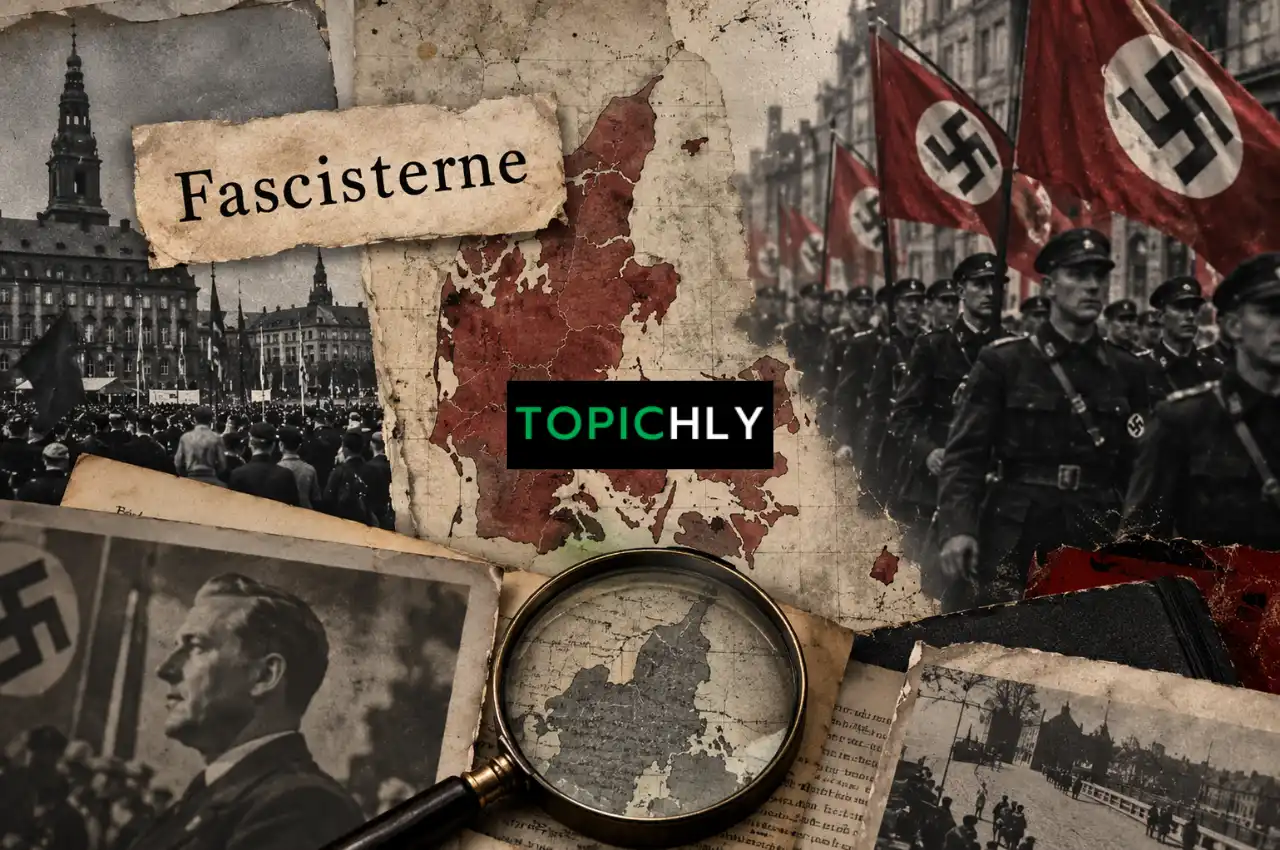
Fascisterne is a Danish word that translates to “the fascists” in English. It refers to people who support fascism, a political ideology that became influential in Europe during the early twentieth century, particularly under Benito Mussolini in Italy and Adolf Hitler in Germany.
Although the word has a simple translation, its historical meaning goes much further. Fascist movements helped reshape European politics between the two world wars, challenged democratic governments, and contributed to some of the darkest events in modern history.
Denmark, where the word fascisterne comes from, also experienced the rise of fascist and Nazi organizations. These groups never achieved the political dominance seen in Germany or Italy, but their activities became particularly important during the German occupation of Denmark from 1940 to 1945.
Understanding fascisterne therefore involves more than learning a Danish word. It also means examining the political beliefs, historical events, and social conditions associated with fascism.
What Does Fascisterne Mean?
In Danish, fascisterne is the definite plural form of fascist, meaning “the fascists.” It describes a particular group of people identified with fascism rather than the political ideology itself.
The distinction is important because fascisterne does not refer to one specific political organization or historical movement.
For example, a Danish history book discussing Mussolini’s government might use fascisterne to describe Italian Fascists. The same word could appear in a discussion of Danish political extremists during World War II.
The surrounding context tells readers which group is being discussed.
The word also has a straightforward grammatical explanation. Danish frequently adds endings to nouns to indicate whether they refer to one person, several people, or a particular group.
Fascisterne: Danish Translation and Related Words
Danish word
English meaning
Fascist
A fascist
Fascisten
The fascist
Fascister
Fascists
Fascisterne
The fascists
Fascisme
Fascism
Fascistisk
Fascist or fascistic
Nazist
A Nazi
Nazisterne
The Nazis
Antifascist
An anti-fascist
The Danish ending “-erne” makes the plural noun definite. In simple terms, fascister means “fascists,” while fascisterne means “the fascists.”
Den Danske Ordbog, an established Danish dictionary, records these grammatical forms and defines a fascist as a supporter of fascism.
Another distinction worth remembering is between fascisterne and fascisme. The first describes people, while the second names the ideology.
These words are connected, but they are not interchangeable.
Where Did Fascism Originate?
The historical roots of fascism are closely connected with Italy following World War I.
The word itself is associated with the Latin term fascis, meaning a bundle. In ancient Rome, bundles of rods, sometimes surrounding an axe, served as symbols of political authority. Known as fasces, these symbols later became associated with Mussolini’s political movement.
Following World War I, Italy experienced considerable political and economic difficulties.
Although Italy had fought on the victorious Allied side, many nationalists believed the country had not received the territorial rewards it deserved.
At the same time, unemployment, inflation, labor unrest, and political disagreements created widespread frustration.
The fear of socialist revolution also influenced sections of Italian society, particularly business owners, landowners, and conservative political groups.
These conditions helped create an environment in which Benito Mussolini could build support for a movement promising national strength, political order, and decisive leadership.
Mussolini and the First Fascist Movement
In 1919, Mussolini established the Fasci Italiani di Combattimento, a political movement that later developed into the National Fascist Party.
His supporters promoted aggressive nationalism and opposed parliamentary democracy, socialism, and communism.
Fascist groups known as Blackshirts also used intimidation and violence against political opponents, including socialists and trade union members.
In October 1922, the movement organized the March on Rome.
Following the political crisis surrounding the march, King Victor Emmanuel III appointed Mussolini prime minister.
Mussolini did not establish complete dictatorial control immediately. Over the following years, his government restricted civil liberties, suppressed opposition parties, weakened independent institutions, and brought the press under tighter control.
By the mid-1920s, Italy had become a Fascist dictatorship.
What Did the Fascists Believe?
Fascist movements differed between countries, but historians identify several beliefs and political practices that appeared repeatedly.
Extreme Nationalism
Fascist ideology placed the nation above individual political interests.
Supporters often presented national unity, cultural identity, and collective strength as more important than personal freedom or political disagreement.
National pride was closely connected with the belief that the country needed a powerful government capable of directing society toward shared political goals.
Authoritarian Leadership
Fascist movements generally favored strong leaders with extensive political authority.
Instead of allowing competing political parties to influence government decisions, they promoted centralized leadership and obedience.
Mussolini’s title, Il Duce, meaning “the leader,” reflected this approach.
The leader was presented as the person capable of expressing and defending the nation’s interests.
Opposition to Liberal Democracy
Historical fascist movements rejected important features of liberal democracy, including political pluralism, independent opposition, and limits on executive power.
They frequently portrayed disagreements between political parties as evidence of national weakness.
Once in power, fascist governments worked to weaken or eliminate political competition.
Political Violence and Militarism
Organized violence was another characteristic of many fascist movements.
Paramilitary organizations intimidated opponents, disrupted political gatherings, and attacked rival groups.
Fascist governments also promoted military discipline, national sacrifice, and displays of collective strength.
Uniforms, marches, mass rallies, and military imagery became familiar features of their political culture.
Propaganda and Social Control
Fascist movements made extensive use of newspapers, radio, speeches, posters, films, and public demonstrations.
Propaganda presented leaders as national heroes and encouraged loyalty to the ruling movement.
It also helped governments promote their political objectives while restricting competing information and criticism.
Not every authoritarian government is fascist, however. Historians usually examine several political, ideological, and historical characteristics together when identifying fascist movements.
Fascisterne in Denmark: The Rise of Danish Fascism
Denmark experienced its own fascist and National Socialist political movements during the 1930s.
However, the Danish situation differed substantially from developments in Italy and Germany.
Denmark remained a parliamentary democracy, and extremist movements failed to gain widespread electoral support.
The most historically prominent Danish Nazi organization was Danmarks Nationalsocialistiske Arbejderparti, usually abbreviated as DNSAP.
The Formation of DNSAP
DNSAP, translated as the National Socialist Workers’ Party of Denmark, was founded on November 16, 1930.
Its first leader was Cay Lembcke, who drew considerable inspiration from Adolf Hitler’s National Socialist German Workers’ Party.
The Danish organization adopted political ideas, symbols, and methods closely resembling those of the German Nazi movement.
These included strong nationalism, antisemitism, opposition to parliamentary democracy, and support for authoritarian leadership.
The party faced a political contradiction, however.
It presented itself as a Danish nationalist movement while closely following an organization associated with another country’s political interests.
This problem became especially apparent during Germany’s occupation of Denmark.
Frits Clausen and the Growth of Danish Nazism
In 1933, Frits Clausen replaced Cay Lembcke as the party’s leader.
Clausen attempted to expand the movement’s influence, particularly in southern Denmark.
Under his leadership, DNSAP gained some members and electoral support, but it never became a major parliamentary force.
In the 1939 Danish parliamentary election, the party received approximately 1.8 percent of the vote and won three seats.
This result demonstrated that a Danish Nazi movement existed, but also showed its limited public appeal.
The party continued operating during the German occupation, although it never succeeded in replacing Denmark’s established political leadership with its own government.
Denmark Under Nazi Occupation
On April 9, 1940, Nazi Germany invaded Denmark.
German military forces crossed the border early in the morning, while aircraft appeared over Danish cities.
Following several hours of fighting, Denmark’s government surrendered in the face of overwhelming German military strength.
Unlike some other occupied European countries, Denmark initially retained its king, government, and parts of its existing political administration.
The Danish authorities pursued a policy of cooperation with the occupying power, partly to preserve a degree of national control and reduce the consequences of occupation.
However, this arrangement did not mean Denmark was politically independent.
German military power remained decisive, and everyday life was affected by rationing, restrictions, censorship, and the growing pressures of war.
The Role of Danish Nazis
Danish Nazis supported Germany’s political objectives, although their influence within Denmark remained limited.
DNSAP hoped that German occupation would create an opportunity for the party to gain political power.
However, German authorities initially preferred working with Denmark’s existing government rather than installing an unpopular Danish Nazi administration.
Some Danish National Socialists also became involved in recruiting volunteers for German military organizations, including the Waffen-SS and Frikorps Danmark.
These activities became deeply controversial because they connected Danish political activists with the military interests of the occupying power.
Danish society was not politically united during the occupation. Some people cooperated with German authorities, others actively resisted, and many attempted to manage everyday life under difficult circumstances.
The choices made during this period remain an important subject of Danish historical research.
Danish Resistance to Nazi Germany
Resistance organizations gradually developed during the occupation.
Their activities included distributing underground newspapers, gathering intelligence, carrying out sabotage, and helping people escape German persecution.
Resistance became more organized as the war continued.
One especially important event occurred in October 1943, when thousands of Danish Jews escaped to neutral Sweden with assistance from fellow Danes.
The rescue became one of the most widely remembered episodes of Denmark’s wartime history.
German occupation ended in most of Denmark in May 1945, although the island of Bornholm remained under Soviet military occupation until April 1946.
The defeat of Nazi Germany also brought an end to DNSAP as an organized political party.
Fascism and Nazism: Are They the Same Thing?
Fascism and Nazism are closely related political movements, but they are not identical.
Italian Fascism developed under Mussolini, while Nazism emerged in Germany under Adolf Hitler.
Both opposed liberal democracy, supported authoritarian leadership, promoted aggressive nationalism, and used political violence.
However, Nazi ideology placed racial hierarchy, antisemitism, and the supposed superiority of an Aryan race at the center of its political worldview.
These beliefs became fundamental to Nazi Germany’s persecution and systematic murder of millions of people, including six million European Jews during the Holocaust.
Italian Fascism initially developed with a different ideological emphasis, particularly around the authority of the state and the nation.
Nevertheless, Mussolini’s government also committed serious human rights abuses, pursued colonial expansion, and introduced antisemitic racial laws in 1938.
The differences should not obscure the political repression and violence associated with both movements.
Feature
Italian Fascism
German Nazism
Main historical leader
Benito Mussolini
Adolf Hitler
Country of origin
Italy
Germany
Rise to national power
1922
1933
Political system
Fascist dictatorship
Nazi dictatorship
Nationalism
Central principle
Central principle
Racial ideology
Became increasingly important
Central from the beginning
Antisemitism
Institutionalized in racial laws in 1938
Foundational ideological element
Political opposition
Suppressed
Suppressed
Historical outcome
Regime collapsed during World War II
Regime defeated in 1945
Nazism is commonly studied as a form of fascism, although historians continue to examine the ideological differences between individual movements.
In Danish writing, fascisterne may refer broadly to fascists, while nazisterne refers specifically to Nazis.
The words can overlap in historical discussions, but they are not exact synonyms.
Why Did Fascist Movements Gain Support?
The rise of fascism cannot be explained by one cause.
Different countries experienced different political circumstances, and not everyone who supported fascist movements did so for identical reasons.
Several historical conditions contributed to their development.
Economic Instability
Economic crises left many Europeans concerned about unemployment, declining wages, and uncertain futures.
The Great Depression, beginning in 1929, made these problems worse across much of Europe.
Extremist movements used public frustration to present themselves as alternatives to established political parties.
Fear of Communism
The Russian Revolution of 1917 and the development of the Soviet Union influenced European politics.
Some business owners, landowners, and conservative political leaders feared similar revolutionary movements in their own countries.
Fascist groups presented themselves as powerful opponents of communism and socialism.
Dissatisfaction With Democratic Governments
Political instability and frequent changes in government contributed to declining confidence in parliamentary institutions in some countries.
Fascist leaders promised decisive action, national unity, and an end to political disputes.
Their promises appealed to some voters who believed democratic governments were unable to solve urgent problems.
National Humiliation and Resentment
The consequences of World War I also mattered.
In Germany, anger over military defeat and the Treaty of Versailles became an important part of Nazi political messaging.
In Italy, nationalists complained that the country had not received sufficient rewards despite being among the victorious Allied powers.
Fascist leaders used these feelings to promote political narratives about national revival.
However, economic hardship or national disappointment did not inevitably lead to fascism. Political institutions, leadership decisions, organized movements, and social conditions all influenced the outcomes.
How Is the Word Fascisterne Used Today?
Fascisterne remains an ordinary Danish word used in historical writing, political discussions, news reporting, and everyday conversation.
Its meaning depends on context.
In a history textbook, the term might refer specifically to Mussolini’s supporters or political movements during the interwar years.
In contemporary political discussion, someone might use it to describe an organization they believe shares characteristics with historical fascism.
There is an important difference between these uses.
When discussing established historical movements, the label may have a clear documented meaning.
When applied to contemporary political organizations or individuals, its meaning may be disputed.
Political commentators and historians do not always agree about which characteristics are sufficient to classify a present-day movement as fascist.
Because of that, it is useful to examine the actual political beliefs, actions, and institutions being discussed rather than relying on the label alone.
Fascisterne in Everyday Danish
The word also appears in ordinary Danish sentences.
For example:
“Fascisterne kom til magten i Italien.”
English translation: “The fascists came to power in Italy.”
Another example is:
“Fascisterne var imod demokratiet.”
English translation: “The fascists were opposed to democracy.”
In both sentences, fascisterne refers to people associated with fascism.
The grammatical meaning remains the same regardless of the historical or political setting.
Why the History Behind Fascisterne Still Matters
Studying fascism helps explain important developments in twentieth-century European history.
It also provides context for understanding the relationship between nationalism, authoritarian governments, political violence, propaganda, and democratic institutions.
The history of Denmark offers a particularly interesting example.
Despite the presence of a Nazi political organization and the pressures created by German occupation, Danish Nazis never gained the widespread electoral support or control achieved by their German counterparts.
At the same time, Denmark’s wartime experience shows that occupation created difficult political and personal choices.
Some individuals supported the occupiers, others resisted, and many lived through the period without belonging to either group.
Understanding these differences helps avoid treating entire national populations as though they shared one political position.
Historical study also makes it easier to distinguish documented political movements from loose or exaggerated comparisons used in modern debates.
Frequently Asked Questions
What does fascisterne mean in English?
Fascisterne means “the fascists” in English. It is the definite plural form of the Danish noun fascist and refers to people associated with fascism.
Is fascisterne a Danish or German word?
Fascisterne is Danish. German uses different grammatical forms, including Faschisten for “fascists” and die Faschisten for “the fascists.”
Does fascisterne mean fascism?
No. Fascisterne refers to people, while fascisme is the Danish word for fascism, the political ideology.
Who were the fascisterne in Denmark?
The term could describe Danish fascists or other fascist movements discussed in Danish historical writing. Denmark’s most prominent historical Nazi party was DNSAP, founded in 1930.
Was Denmark a fascist country during World War II?
Denmark was occupied by Nazi Germany between 1940 and 1945, but it did not become a fascist state through a Danish fascist party taking power. Danish authorities initially continued functioning under German occupation.
What is the difference between fascisterne and nazisterne?
Fascisterne means “the fascists,” while nazisterne means “the Nazis.” Nazism is closely related to fascism but has specific ideological characteristics, particularly its racial doctrines and antisemitism.
Who started fascism?
Benito Mussolini was the central figure in establishing the first successful Fascist political movement and dictatorship in Italy. He founded the Fasci Italiani di Combattimento in 1919 and became Italian prime minister in 1922.
Is fascisterne still used in modern Danish?
Yes. The word continues to appear in historical discussions, political commentary, and ordinary Danish writing. Its exact reference depends on the surrounding context.
Final Thoughts on Fascisterne and Its Historical Meaning
Fascisterne may look unfamiliar to English-speaking readers, but its literal meaning is straightforward: “the fascists.”
The history behind the word is considerably more complex.
Fascism emerged as a political movement in Italy after World War I, spread through parts of Europe, and became associated with authoritarian leadership, extreme nationalism, political repression, and organized violence.
Denmark had its own fascist and Nazi organizations, including DNSAP, but these movements never achieved the dominance seen in Italy or Germany.
The German occupation of Denmark nevertheless brought the country directly into the history of Nazism, collaboration, and resistance during World War II.
Today, fascisterne remains a useful word for understanding Danish historical writing and political discussions. Its precise meaning depends on which people or movements are being described.
Recognizing that distinction helps readers understand both the language and the history without confusing fascism, Nazism, and the different political movements associated with them.















No Comments