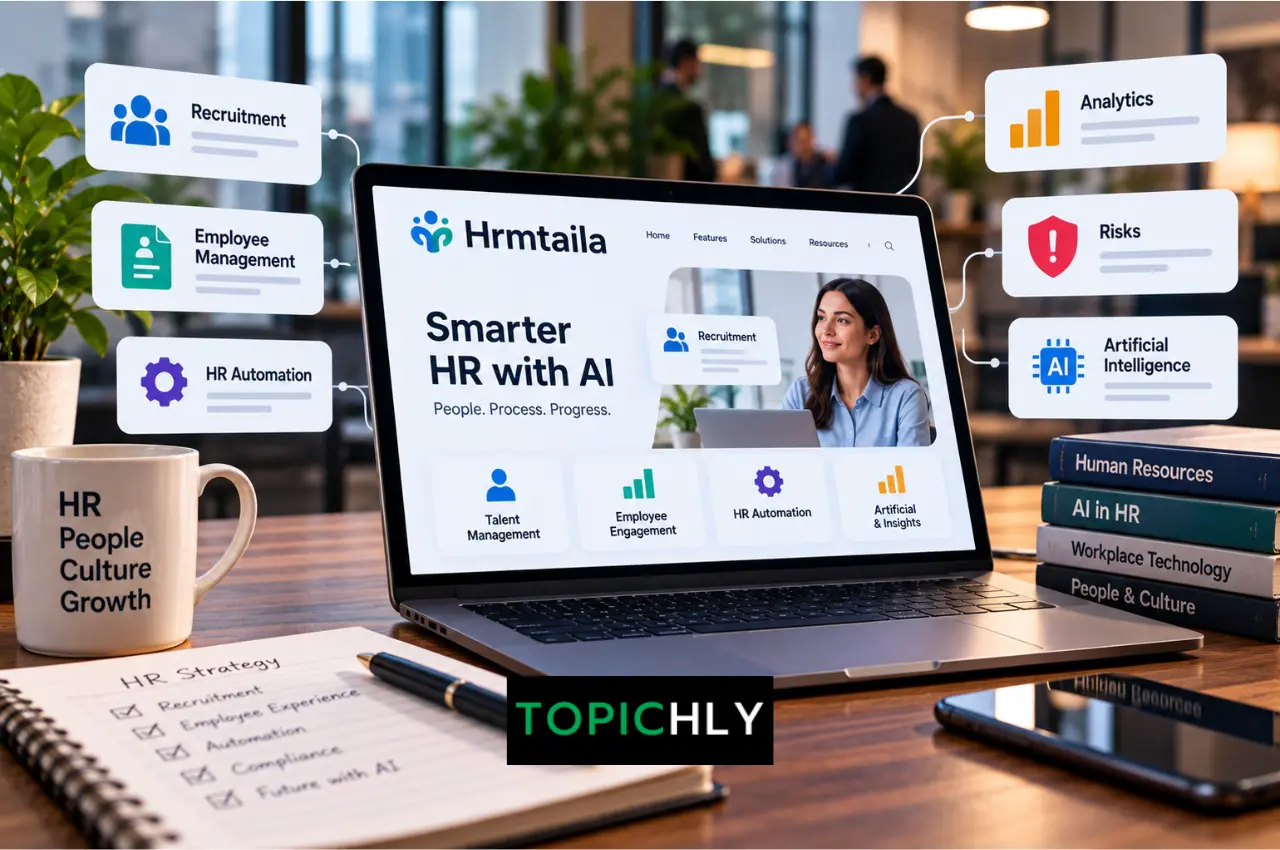
Hrmtaila is an emerging online term associated with artificial intelligence (AI), human resource management, and workplace automation. It has appeared in articles discussing how businesses can use technology to manage recruitment, employee records, payroll, and other HR responsibilities.
Some websites describe Hrmtaila as an AI-powered human resources platform capable of simplifying everything from hiring to employee performance management. However, there is an important distinction between those descriptions and what can actually be verified.
At present, Hrmtaila has no clearly established identity as a commercial software product. There is no confirmed developer, official product website, pricing structure, or independently verified customer base associated with the name.
That doesn’t make the subject irrelevant. The technologies frequently connected with Hrmtaila are already being used in modern workplaces. Understanding those technologies, and separating genuine capabilities from unverified claims, provides a much clearer picture of what the term represents.
What Is Hrmtaila?
Hrmtaila is a relatively new term that online publications use to describe the combination of artificial intelligence and human resource management (HRM).
In this context, it refers to the idea of using software, automated workflows, and data analysis to handle routine HR activities more efficiently.
Think about the responsibilities of a typical HR department. Employees need to be recruited, salaries calculated, attendance recorded, leave requests processed, and workplace policies communicated.
Traditionally, many of these tasks involved paperwork, spreadsheets, emails, and manual data entry.
Modern HR systems can bring much of this information into one digital environment. Artificial intelligence can then assist with activities such as organizing job applications, answering common employee questions, and analyzing workforce data.
That is the general approach associated with Hrmtaila.
However, the word itself does not have an officially recognized definition. The letters “HRM” correspond to the established abbreviation for human resource management, but the meaning and origin of the remaining letters have not been reliably documented.
It is therefore more accurate to understand Hrmtaila as an emerging expression connected with AI-assisted HR technology than as the confirmed name of a specific application.
Hrmtaila: Important Facts and Current Status
Detail
Information
Name
Hrmtaila / HRMtaila
Common association
AI-powered human resource management
Main field
Human resources and workplace technology
Official definition
Not established
Verified software product
Not confirmed
Known developer
Not identified
Official website
Not verified
Company headquarters
Unknown
Main technologies discussed
AI, automation, cloud HR systems, data analytics
Potential applications
Recruitment, onboarding, payroll, employee support
Pricing or subscription
Not verified
Mobile application
Not confirmed
Commercial availability
Unclear
These details matter because several online explanations discuss Hrmtaila as though a complete commercial application already exists.
Without independent documentation, specific product capabilities should not be presented as established facts.
Where Did the Name Hrmtaila Come From?
The origin of Hrmtaila remains uncertain.
Articles discussing the term appeared across several websites during 2026. Most connect it with artificial intelligence, human resources, and employee management.
However, no reliable original announcement has been identified that establishes who created the word or why it was chosen.
The beginning of the name resembles “HRM,” the standard abbreviation for human resource management.
The remaining portion, “taila,” has no confirmed meaning in this context.
It might be a coined brand name, an experimental technology term, or simply an expression that became popular through online publishing. There is not enough evidence to establish one explanation.
This is an important reminder about unfamiliar technology terminology.
When several websites repeat the same description, that repetition can make a term appear more established than it actually is.
A confirmed software product would normally have identifiable documentation, a company or developer, and some way to examine its functionality.
Those details have not been established for Hrmtaila.
Is Hrmtaila a Real AI-Based HR Software Platform?
There is currently insufficient reliable evidence to identify Hrmtaila as an established commercial HR software platform.
Various articles attribute capabilities such as recruitment automation, employee monitoring, payroll management, and predictive analytics to the name.
However, no verified application demonstration or official technical documentation has been identified supporting those claims.
The distinction is important because the technologies themselves are real.
AI recruitment tools exist. Cloud-based HR management systems exist. Automated payroll software and employee self-service portals are also widely available.
But their existence does not prove that a particular product called Hrmtaila provides them.
What Would Confirm Hrmtaila as a Real Product?
A genuine commercial software platform would usually provide information such as:
An identifiable company or developer
An official website with product documentation
A working demonstration or accessible application
Clear descriptions of available features
Customer support and contact information
Privacy and data security policies
Pricing or enterprise sales arrangements
Verifiable customer experiences
Some legitimate enterprise software products do not publish prices or offer open registration. Therefore, missing one feature does not automatically mean a product is fictional.
However, when nearly all identifying information is absent, it becomes difficult to verify the product’s existence or advertised capabilities.
Until stronger evidence emerges, Hrmtaila should not be treated as a confirmed software provider.
How Hrmtaila Relates to Modern Human Resource Management
Although Hrmtaila’s identity is uncertain, the broader concept associated with it is straightforward.
Modern HR technology combines employee information, administrative processes, and automated systems to support the people responsible for managing a workforce.
Artificial intelligence adds another layer by helping systems process information, recognize patterns, and respond to routine requests.
For example, a traditional HR database might store an employee’s annual leave balance.
An AI-supported HR assistant could potentially answer questions about the balance, explain the company’s leave policy, and direct the employee to the appropriate request form.
Similarly, a conventional recruitment system might store hundreds of job applications.
An AI-assisted system could help recruiters organize those applications according to relevant experience and stated qualifications.
In both cases, technology supports the HR department rather than replacing its responsibility for important decisions.
The following areas illustrate how the approach associated with Hrmtaila could apply to real workplaces.
AI Recruitment and Candidate Screening
Recruitment is one of the most discussed applications of artificial intelligence in human resources.
A company advertising a popular position might receive hundreds of applications within a few days.
Recruiters then need to review qualifications, compare experience, schedule interviews, and communicate with candidates.
This can require substantial time.
AI-supported recruitment systems can assist by organizing applications, extracting relevant information, and highlighting candidates who appear to meet specified requirements.
Some systems can also automate interview scheduling and send routine updates.
A Practical Recruitment Example
Imagine a company wants to hire five customer service representatives.
It receives 400 applications.
Instead of opening every CV individually to locate basic qualifications, recruiters use a recruitment platform to organize applicants by relevant experience, language skills, and stated availability.
The software helps identify applications that deserve closer attention.
However, recruiters still need to assess the candidates fairly.
An automated system may misunderstand unusual career histories, overlook transferable skills, or produce results influenced by biased training data.
For that reason, important hiring decisions should involve appropriate human review.
These are capabilities of existing AI recruitment technology, not verified features of a Hrmtaila application.
Employee Onboarding and Workplace Automation
Onboarding refers to the process of helping a new employee join an organization successfully.
It can involve employment documents, payroll registration, training, account creation, equipment requests, and introductions to company policies.
In an organization with many new employees, coordinating these activities manually can be difficult.
Digital onboarding systems allow HR departments to organize tasks and monitor progress.
For example, when an employee joins, a system could automatically:
Send a welcome email.
Provide the employee handbook.
Request necessary employment documents.
Notify the IT department about account setup.
Assign introductory training.
Remind the employee about incomplete tasks.
This reduces the need for HR staff to send repeated messages or track every activity manually.
Artificial intelligence can also help answer straightforward questions about company procedures.
However, onboarding involves human relationships as well as paperwork.
A new employee may need reassurance, individual instruction, or support with an unfamiliar workplace situation.
Technology can handle administrative tasks, but it cannot fully replace personal communication.
Hrmtaila and Employee Self-Service
Employee self-service is another important feature of modern HR software.
In a traditional workplace, employees might contact HR every time they need a payslip, leave balance, employment letter, or change to their personal information.
A self-service portal allows employees to complete some of these activities directly.
For example, an employee could sign in and check their remaining annual leave without waiting for an HR representative.
A manager might then approve the request through the same system.
AI assistants can make these portals more convenient by helping employees find information using ordinary language.
Instead of searching through a lengthy policy document, an employee could ask a question about leave eligibility or available benefits.
However, chatbot responses must be accurate and based on current company policies.
Incorrect information about salaries, benefits, or employment rights can create real problems.
Employees should always have a way to contact a qualified HR representative when automated information is unclear or incorrect.
Workforce Analytics and Employee Performance
Organizations collect information about recruitment, attendance, employee turnover, training, and workforce expenses.
Workforce analytics helps turn that information into reports that managers can understand.
For example, a company may want to know why one department experiences more employee resignations than others.
An analytics platform could show differences in turnover rates, average tenure, recruitment costs, or overtime.
These figures may help managers identify questions worth investigating.
However, statistical patterns do not necessarily explain the underlying causes.
Higher turnover might relate to management practices, job demands, compensation, local labor conditions, or other factors.
Can AI Evaluate Employee Performance?
AI can help organize performance-related information, but automated evaluation has limitations.
An employee’s contribution is not always reflected in easily measured figures.
For instance, two customer service workers might handle different types of customer problems.
One employee could resolve fewer cases because they are assigned more complicated issues.
A simplistic automated system might incorrectly interpret this as weaker performance.
Human judgment, context, clear standards, and appropriate review procedures are important when using workplace analytics.
Decisions involving promotion, compensation, disciplinary action, or termination should not rely solely on unexplained AI-generated scores.
Payroll Management and HR Automation
Payroll is another area where businesses commonly use specialized software.
A payroll system may process salary information, attendance records, overtime, deductions, and other employment-related figures.
Automation can reduce repetitive data entry and help identify inconsistent records.
For example, an integrated system could transfer approved attendance information into payroll calculations.
This may reduce the need to copy the same numbers between multiple spreadsheets.
However, payroll mistakes can directly affect employees.
An incorrect deduction or overtime calculation may cause financial difficulties and require correction.
That makes validation especially important.
Companies also need to consider local employment laws, taxes, benefits, and recordkeeping requirements.
A payroll system designed for one country may not support the requirements of another.
Although payroll automation is frequently mentioned in articles about Hrmtaila, no working Hrmtaila payroll product has been independently verified.
Potential Benefits of AI-Assisted HR Systems
Businesses adopt HR technology for several reasons.
The most obvious is reducing repetitive administrative work, but there are other potential benefits.
Potential benefit
Practical example
Faster administration
Automatic onboarding reminders
Better record organization
Centralized employee information
Reduced manual data entry
Connected attendance and payroll records
Easier employee access
Self-service leave applications
More consistent workflows
Standard onboarding checklists
Improved reporting
Workforce turnover analysis
Quicker routine responses
AI-assisted policy questions
Better planning support
Reports about hiring and staffing needs
These benefits depend on the quality of the software, its configuration, and the organization’s existing procedures.
Automation does not automatically solve every administrative problem.
A poorly designed process can remain inefficient even after software is introduced.
Similarly, inaccurate employee records can produce misleading reports regardless of how advanced the analytics system appears.
The best results generally come from combining appropriate technology with reliable information and sensible workplace procedures.
Risks and Limitations of AI in Human Resources
AI-supported HR systems can be useful, but they also introduce risks that organizations should understand.
Employee Privacy
HR departments handle sensitive personal information.
This may include salaries, addresses, identity documents, employment records, and information about workplace complaints.
Businesses need suitable access controls and secure data handling practices.
Using an AI service can raise additional questions about where information is processed, how long it is stored, and whether it is used for other purposes.
Bias in Automated Decisions
AI systems can reproduce patterns found in their training data or the information used to configure them.
If historical employment decisions contain unfair patterns, an automated tool may repeat or reinforce those problems.
Organizations should evaluate how recruitment and assessment systems perform across relevant groups and investigate possible unfair outcomes.
Incorrect or Misleading Outputs
AI-generated answers can be inaccurate.
An employee asking about leave eligibility might receive a response based on an outdated policy.
A manager reviewing an analytics report might also misinterpret a prediction as a confirmed fact.
Important outputs should be checked before action is taken.
Excessive Employee Monitoring
Some workplace technologies can measure activity, attendance, productivity, and communication patterns.
Collecting more information does not necessarily produce better management decisions.
Excessive monitoring can raise privacy concerns and affect workplace trust.
Employers should consider whether particular forms of monitoring are necessary, proportionate, lawful, and clearly explained.
Hrmtaila vs. Established HR Software
Businesses interested in the ideas associated with Hrmtaila do not need to depend on an unverified product.
Several established HR software providers offer documented systems for managing employees and workplace processes.
Examples include Workday, SAP SuccessFactors, BambooHR, and Zoho People.
These platforms serve different types of organizations and provide varying combinations of HR management, automation, payroll-related functionality, reporting, and employee services.
Feature
Hrmtaila
Established HR platforms
Confirmed software identity
Not established
Yes
Official developer
Not verified
Identifiable
Product documentation
Not found
Generally available
Recruitment features
Claimed in articles
Available in selected products
Employee records
Unverified
Common
AI-assisted functions
Unverified
Varies by platform
Payroll features
Unverified
Depends on provider and region
Pricing
Unknown
Available through published plans or quotations
Customer support
Not established
Documented support arrangements
This comparison does not suggest that all established platforms provide identical features.
A small business may need a relatively simple employee management system, while a large multinational organization may require sophisticated payroll, workforce planning, and compliance capabilities.
The right choice depends on the organization’s actual requirements.
How to Evaluate an AI-Powered HR Platform
Whether a business is researching Hrmtaila or another unfamiliar HR technology, there are practical ways to evaluate the product before adopting it.
Start by identifying the problem that needs solving.
A company struggling with onboarding may not need an expensive workforce analytics platform.
Similarly, a business with payroll errors should first investigate whether the problems come from inaccurate attendance records, poor processes, or software limitations.
Once the requirements are clear, examine the software provider.
Ask for a product demonstration using realistic tasks.
Confirm the available integrations, security arrangements, pricing, and support options.
For example, a company considering an automated recruitment system could test how the software handles applicants with different employment histories.
It should also establish whether HR staff can correct mistakes and override automated recommendations.
Data protection deserves particular attention because employee information is often sensitive.
Contracts should explain how data is stored, processed, accessed, and handled when the customer stops using the service.
Is Hrmtaila Free or Paid?
No verified pricing structure has been established for Hrmtaila.
Some online articles discuss potential HR software features but do not identify a confirmed provider selling the product.
Consequently, claims about free trials, monthly subscriptions, enterprise plans, or premium features should be treated cautiously.
There is also no independently verified official Hrmtaila mobile application or downloadable desktop software.
If a website claims to provide a Hrmtaila download, users should confirm the identity of the publisher before installing anything.
This is especially important for HR applications because they may request access to employee records or organizational information.
Frequently Asked Questions
What is Hrmtaila?
Hrmtaila is an emerging online term associated with artificial intelligence and human resource management. It is commonly used when discussing recruitment automation, employee management, workforce analytics, and digital HR systems.
Is Hrmtaila a real software company?
A verified software company operating under the name Hrmtaila has not been established through reliable public information. Its developer, official website, and commercial product details remain unconfirmed.
What does Hrmtaila stand for?
There is no confirmed official expansion of the complete word. The first three letters, HRM, commonly stand for Human Resource Management, but the meaning of the remaining letters has not been established.
How does Hrmtaila work?
Articles generally associate Hrmtaila with AI-supported HR processes such as recruitment screening, onboarding, employee support, and analytics. These are examples of existing HR technology, not verified capabilities of a specific Hrmtaila product.
Can Hrmtaila manage payroll?
Some descriptions connect Hrmtaila with payroll automation. However, no independently verified Hrmtaila payroll system has been identified.
Is Hrmtaila available as a mobile app?
No official mobile application associated with a confirmed Hrmtaila developer has been established.
Does Hrmtaila use artificial intelligence?
The term is frequently associated with AI-powered HR management, but no verified proprietary AI system operating under the name has been documented.
Who created Hrmtaila?
The origin of the term remains unknown. No identifiable creator or organization has publicly established a reliable original definition.
Is Hrmtaila safe to use?
There is insufficient information to assess the security of a specific Hrmtaila product because a verified application has not been established. Any software claiming this name should be evaluated independently before receiving employee information.
Understanding Hrmtaila: The Bottom Line
Hrmtaila is an emerging term associated with artificial intelligence and human resource management, but its identity as a commercial technology product remains unverified.
Articles describing the term commonly discuss recruitment automation, onboarding, payroll management, employee self-service, and workforce analytics.
These are genuine areas of modern HR technology, and businesses already use established software to perform many of these tasks.
However, there is no reliable basis for attributing a complete set of working features, pricing plans, or customer results to a specific Hrmtaila platform.
For readers researching the term, the distinction between the concept and a confirmed product is essential.
For employers considering AI-powered HR software, the better approach is to begin with clearly defined business requirements, examine providers with verifiable products, and carefully assess data privacy, fairness, and human oversight.
Hrmtaila may eventually develop a more definite identity. Until then, it is best understood as an uncertain online term connected with a real and growing field of workplace technology.














No Comments